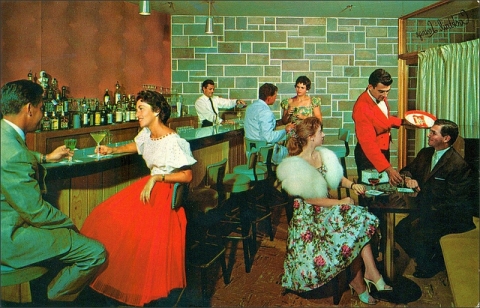
Above: The Flager in South Fallsburg in the 1950s Catskills. Image from 1950s Unlimited via Flickr.
To the wider world, the Catskills mean just one thing: The Borscht Belt, with its famous Jewish resorts that inspired the movie “Dirty Dancing.”
But Grossinger’s, Kutsher’s and the Concord only take up about two-and-a-half chapters of “The Catskills: Its History and How it Changed America,” a new book released by Knopf on Oct. 27.
 That surprised even its author, veteran entertainment journalist and writer Stephen Silverman.
Left: Stephen Silverman. Photo via the Catskill Mountain Foundation.
Telling the story of the Catskills required five years of research and 450 pages. It’s the longest book Silverman had ever written.
“This is 150,000 words,” Silverman said. “You’re talking to somebody who is used to writing 200 words for People Magazine.”
By heft alone, it’s a coffee-table book—a big, glossy hardcover brick stuffed with four centuries of Catskills lore.
It's lavishly illustrated and intended for a mainstream audience that is once again rediscovering the region. (As the book shows, the Catskills have been discovered and re-discovered roughly every 50 years since the 17th century.)
There’s the well-known history, like the story of how Jennie Grossinger created a world-famous Jewish resort out of her family’s Sullivan County boardinghouse. There are quick biographical sketches of the lives of must-mention 19th-century celebrities Jay Gould and John Burroughs. And there’s a snappy account of how Washington Irving wrote the legend of Rip Van Winkle.
But the best parts mine a rich vein of more obscure Catskills stories.
Promenading tourists find a gangster stabbed to death and strapped to a slot machine floating in Sullivan County’s Swan Lake in 1937.
Father Divine, the charismatic leader of the integrated Universal Peace Mission Movement, brings thousands of followers Ulster County in the 1930s.
Mark Carr, an enterprising farmer, invents the idea of commercial Christmas tree sales in America.
At Casa Susanna, a 1950s retreat in Jewett, a small colony of cross-dressers learn how to apply makeup and walk properly in a pair of pumps.
“Illegal liquor. Religious cults. Gangsters. Left-wing children being raised on communist work songs," Silverman said. "You had restricted hotels that had signs that read, “No dogs and no Jews,” and then you had Jews. Murders took place. Religious salvation took place. There was the bluestone mining and leather tanning. It was a lively place.”