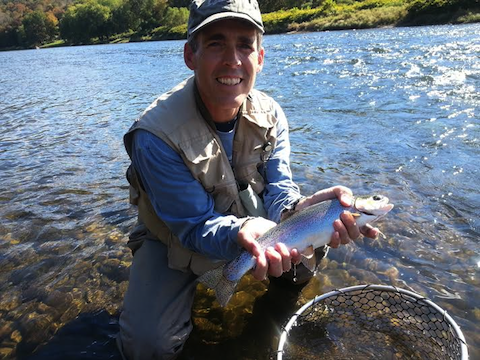
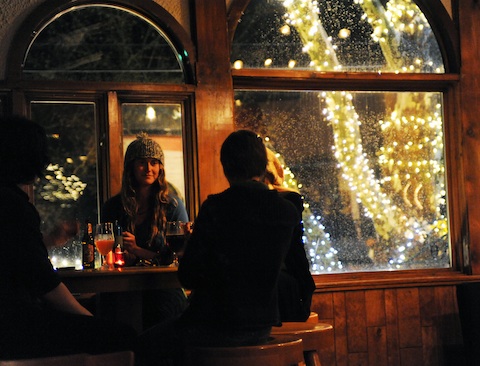
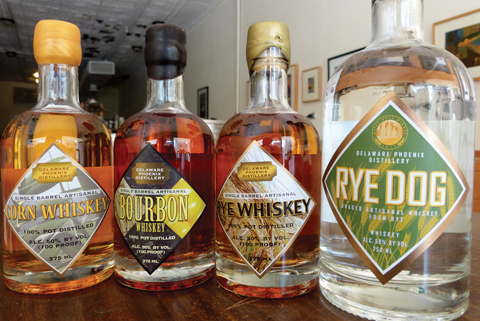
Above: Delaware Phoenix began with absinthe and has recently expanded into whiskey. Photo by Jacob Pucci.
Delaware Phoenix Distillery grew out of a personal hobby and an 8-gallon still.
Proprietor Cheryl Lins, a pioneer among upstate New York spirits makers, began experimenting with making absinthe back in 2006, a couple of years after moving to Delaware County from New Mexico.
“I like to say I crash-landed here,” she said. “I needed a change of climate.”
She traded desert heat for long, snowy winters, and then decided to heed her friends, who, after tasting her spirits, urged her to trade in her careers as a computer programmer and an artist as well.
Today, Lins is still a one-woman show, but her absinthes, and more recently, whiskeys, have earned accolades far beyond her Catskills and New York City markets—and helped launch a mini-boom of upstate New York distilleries.
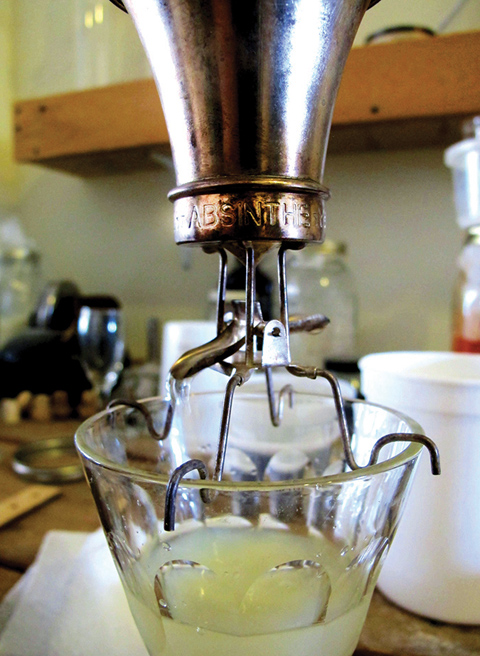
Left: Absinthe in the making. Photo by Lucille Huffman.
When Lins opened Delaware Phoenix in 2009 with two versions of absinthe, Meadow of Love and Walton Waters, she was the first in the Empire State to produce the formerly outlawed concoction, two years after the federal government relaxed its rules on sales of the “green fairy.” Lins’ products almost immediately made waves through the burgeoning absinthe community, both here and abroad.
In 2010, the New York International Spirits Competition awarded gold medals to her Walton Waters absinthe and her Rye Dog whiskey. Reviewers at the Wormwood Society, a consumer education and advocacy group named after one of the primary ingredients in absinthe, rate Meadow of Love as the second-best traditional absinthe worldwide. Both Walton Waters and Blues Cat, a limited-time product produced in 2011, rank in the group’s top 15.
The process to make Delaware Phoenix a reality began in earnest in 2007, soon after Lins’ new hometown of Walton was hit by a devastating flood. That event prompted the name for her distillery: “Delaware” for the county and the river that runs through it, and “Phoenix” from the mythical bird that rises from the ashes of its predecessors.
Lins applied for state and federal licenses, a process that took roughly 18 months and a sizable upfront financial commitment. Under current law, prospective distillers must obtain a workable commercial location that fits within certain guidelines and purchase and set up all the distilling equipment—all without the promise that the equipment can even be used. In addition, Lins had to get special permission to distill within the village of walton, as zoning did not permit it.



 You Catskills folks are a talented bunch.