

The unfinished business of recovery: Schoharie Valley five years after Irene
Above: A widely-circulated photo of the flooded Schoharie Valley during Tropical Storm Irene in 2011, as seen from the top of the cliffs of Vroman’s Nose. Photo by Amy Colyer Fogerty.
The air was perfectly calm in the late hours of Saturday, August 27, 2011. A hurricane was heading north up the East Coast, with forecasters saying that there was a chance that the storm would push inland in New York and impact the Catskills region.
It had been raining heavily for weeks, and the creeks were swollen. So, too, was the Gilboa Dam, which holds back 19.6 billion gallons of drinking water bound for New York City in a reservoir on the Schoharie Creek. Within 24 hours of that calm Saturday evening, all of the Schoharie Valley was forever changed.
This article is part of our series of stories commemorating the five-year anniversary of Tropical Storm Irene in the Catskills.
When the floodwaters caused by Tropical Storm Irene came rushing down the Schoharie Creek five years ago on Sunday, August 28, 2011, the communities that line the Schoharie Creek in the Schoharie Valley were inundated.
Thousands of acres of farmland, hundreds of homes and dozens of businesses were destroyed in a single day. The rising waters of the creek washed the historic Blenheim Covered Bridge off of its abutments and completely obliterated the first floor of the county jail.
Everything located on the valley’s fertile floor was caught in the devastation, as the floodwaters turned the banks of the creek into a miles-long path of debris and destruction.
The flood forced the Schoharie Valley into a state of prolonged recovery, which has taken many different forms over the past five years.
Today, signs of damage caused by the flood are still visible across the county. But there are also many signs of resilience.
For some communities, recovery has meant paving roads and fixing houses. In others, recovery has meant revitalizing downtown districts and inviting new businesses to move in.
Progress is evident at every turn you take in the Schoharie Valley, but so is the unfinished business of recovery.
Reminders of disaster; signs of recovery
The village of Middleburgh, which saw its Main Street covered in water and mud during the flood, now stands as the crown jewel of the Schoharie Valley’s recovery.
Business that survived the flooding on Main Street Middleburgh, such as the Conglomerate and Hubie's Pizzeria, have reopened, while new shops, such as the Green Wolf Brewing Company brewpub and the Green Iguana restaurant, have appeared, along with new murals and floral plantings, the results of a recent beautification effort.
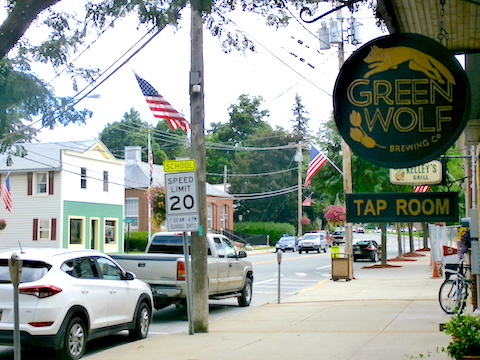
Above: Since the flood, the village of Middleburgh has enjoyed a renaissance, with new businesses, like the Green Wolf Brewing Company, opening on Main Street. Photo by Timothy Knight.
Down the road, the village of Schoharie, where dozens of homes were permanently destroyed by the flood, is regaining its footing more slowly.
On one side of Schoharie's busy Main Street is the county office building, which is currently under construction in response to Irene. Officials are installing a floodgate as a preventive measure against future flooding.
Across the street, many buildings sit empty, with some still displaying notices that they are unfit for human occupancy.
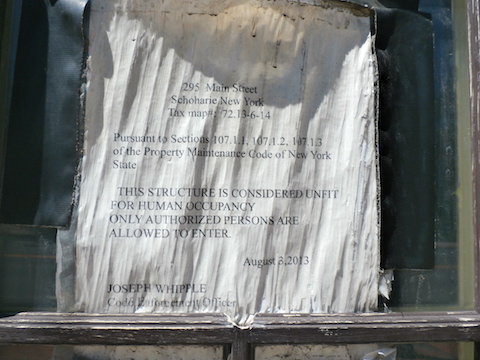
Above: A fraying 2013 notice in the window of a building on Main Street in the village of Schoharie stating that the structure is unfit for human occupancy. Photo by Timothy Knight.
But thanks to the work of flood organizations such as Schoharie Area Long Term (SALT), Schoharie Recovery and the Schoharie Promotional Association, the village has again reached a sense of normalcy.
That feeling extends throughout the Schoharie Valley. The town of Fulton’s fertile soils are teeming with life and growth, where five years ago they were covered with water, as captured in a widely-circulated photo taken from the cliffs of Vroman’s Nose during the flood. (See the top of this story.)