Democratic Congressional hopefuls debate in Woodstock; find little to disagree about
Above: Zephyr Teachout, left, debates Will Yandik, right, in a discussion moderated by Brian Hollander, center, in Woodstock on Tuesday. Photo by Timothy Knight.

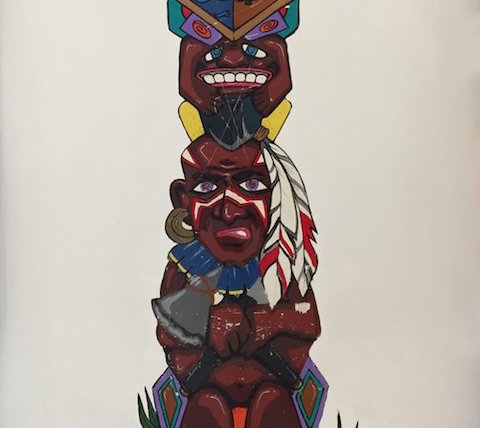
Above: One of many depictions of the Onteora Indian at Onteora Central School. Photo via the Onteora Humans Rights Club.
At a meeting on Tuesday, June 7, the Onteora Central School District Board of Education voted 5 to 2 to change the school’s mascot from the Onteora Indians to the Onteora Eagles.

Above: Andrew Heaney. Photo courtesy of the Heaney campaign.
Unlike the other three candidates running to replace retiring Republican Congressman Chris Gibson in New York's 19th Congressional District, Dutchess County businessman Andrew Heaney has no experience in politics.

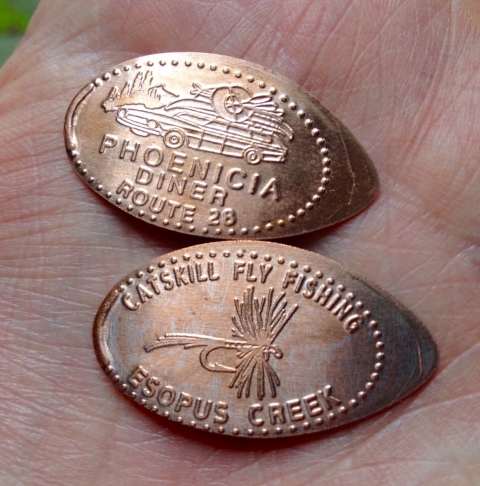
Above: Souvenir pennies made by the new machine in Phoenicia. Photo by Brett Barry.
Kitsch-lovers rejoice! You can squish one of four Catskills-specific designs onto a souvenir penny in the Ulster County hamlet of Phoenicia using a hand-cranked machine that has been installed on Main Street.
Above: The Maynard School in Bovina. Photo by Stephen O’Grady.
Children once walked from their families’ far-flung farms to the Maynard School, a one-room schoolhouse in the Delaware County town of Bovina, cutting across fields to minimize the mileage. The white-painted clapboard structure on Bovina Road was built in 1849, and teachers held classes here until 1959, when the school closed.
But today the building, owned by the town of Bovina, is remarkably preserved, from the flagpole out front to the rows of low wooden desks facing the chalkboard inside. And on Saturday, June 4, four former students—who arrived via automobiles this time—were among approximately two dozen people attending the unveiling of a historic marker that was recently installed at the site.
“It’s the only one-room schoolhouse in Bovina that still looks like a one-room schoolhouse inside and out,” said Bovina historian Ray LaFever, who organized the event and kicked things off by giving a short talk on the history of schools in Bovina.
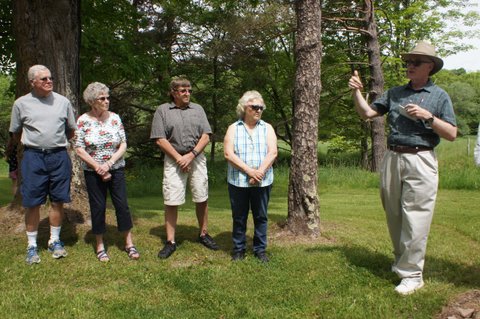
Above: Bovina historian Ray LaFever speaks at a ceremony at the Maynard School on June 4. Photo by Stephen O’Grady.
The Maynard School, so-named because it was built on the property of Elisha Maynard, an early settler of Bovina, was one of 13 small schoolhouses sprinkled throughout the area. The first was built in 1808. By 1820, when the town of Bovina was officially founded, there were five school districts, each with a corresponding schoolhouse. Of a population of around 1,200 that year, about 400 were children aged five to 15, and over half of them attended school. By the 1850s, Bovina had its full complement of 13 schools.
Typically, there were summer and winter sessions. Usually, a female teacher taught in the summer term and a male teacher oversaw the winter term when older boys, who worked the fields during the summer, joined the student body. (It was believed that the male teachers were needed to handle the older boys, according to LaFever.)
After the 1860s, Bovina's population declined, and so did its number of schoolchildren. The population loss, combined with an effort by New York State to consolidate schools, resulted in the closing of Bovina’s one-room schoolhouses and the transfer of students to larger schools in Andes and Delhi.
In 1923, Bovina’s Yankeetown School on Cape Horn Road burned to the ground on Halloween night. It is not known whether a prankster or a disgruntled student was involved, but that school’s children began attending the Maynard School.
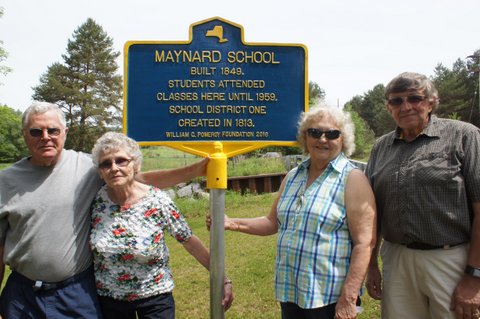
Above: Former students who went to school in the Maynard School pose by an historical marker at the site on June 4. From left, they are Richard Parsons, Jean Merenberg, Rosemary Goedel Stewart and John Weber. Photo by Stephen O’Grady.
By the 1950s, the Maynard School was one of only two Bovina schools left.

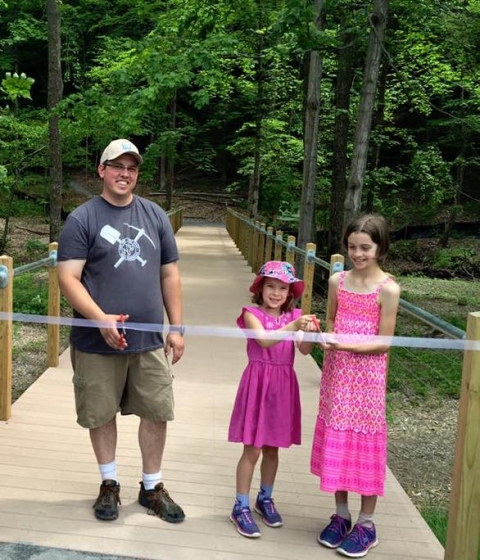
Above: Doug Senterman, the Catskills Program Coordinator of the New York-New Jersey Trail Conference, cuts the ribbon on a new 0.5-mile trail at the Maurice D. Hinchey Catskill Interpretive Center. Photo courtesy of Doug Senterman.
On Saturday, June 4, a new trail hiking trail opened at the Maurice D.Hinchey Catskill Interpretive Center in the Ulster County town of Shandaken.
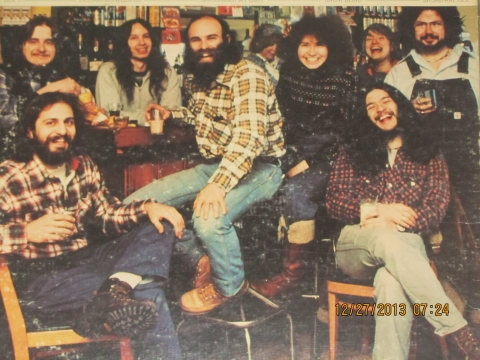
Above: Peggy O'Connell appeared on the back cover of “Oceans between Us,” a 1978 album by the Allen Harris Band, released by Tappan Zee Records/Columbia Records. Standing left to right are: Kim Wroble (bass) Mike Kimmel (guitar/vocals), Peggy O'Connell (in the middle, in background), Mandy Rosenblatt and far right standing Allen Harris (guitar/vocals). Sitting left to right: Larry Smith (piano/sax), Robert Rosenblatt (aka Blatts) (congas), Christine Cordone (guitar/vocals) and Rob Leon (lead guitar). Photo courtesy of Christine Cordone.
Margaret “Peggy” Grant O'Connell, the owner of the Pine Hill Tavern who was a patron of the 1970s Catskills music scene and a mother to many, died on Thursday, May 12 at HealthAlliance Hospital in Kingston after losing an 11-month battle with breast cancer. She was 82 years old. A celebration of her life is planned for Monday, June 6.
A lover of music, books and her dog Zorro, whose ashes will be buried alongside her, O'Connell dispensed motherly love and presided over a booming local music scene from behind the bar at the Pine Hill Tavern (now Zephyr Restaurant) in the Ulster County hamlet of Pine Hill from 1976 to 1982.
"We used to call her Mother Teresa," said her son, James Michael O'Connell, with whom Peggy lived with in the hamlet of Olivebridge for the last five years of her life.
"Mom was a people person,” he said. “She liked everybody; she never had a bad word to say about anyone."
During the 1970s, in the wake of the 1969 Woodstock Festival, bands performing original tunes flocked to the Catskills, looking for nurturing venues to host them as they honed their skills.
The Pine Hill Tavern, located on the westernmost edge of Ulster County just off Route 28, was often their last stop.
Often known just as "Peggy's Place,” the tavern was not just a bar—it was a home away from home for traveling musicians and others in need.

The town of West Fulton may be tiny, but it has a lot of heart—and art.
“West Fulton is a very interesting place, made up of extremely creative people,” said Cornelia McGiver, the artistic director of Panther Creek Arts, a new arts venue in the small Schoharie County town. “And what I find special about that place is that there is a willingness to exchange and complement ideas.”

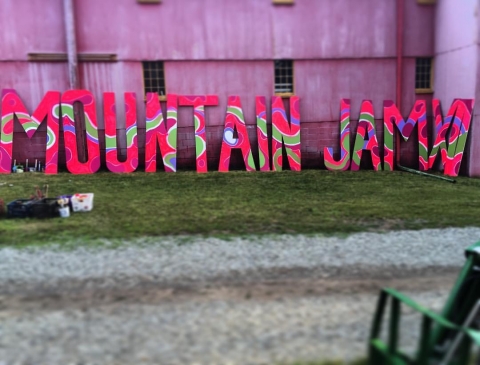
Photo via the Mountain Jam Festival's Facebook page.
Late spring in the Catskills means fishing, camping, and, if you’re a live music fan, Mountain Jam.
Originally conceived in 2004 as a one-day celebration of Woodstock radio station WDST’s 25th anniversary, the festival soon expanded to two days, then three.

Above: Bartender James Reber makes a Moscow Mule with freshly-squeezed ginger at the Woodnotes Grille. Photo by Julia Reischel.
The Emerson Resort and Spa, once known as Catskill Corners, was built in 1996 in buildings that once housed a dairy farm along Route 28 in Mount Tremper, a hamlet in Ulster County.