Rosendale Theatre Collective wins 50K from Pepsi

Not bad for a tiny little town that wants to revitalize its movie theater. From an email that the Collective sent out this morning: 

We did it!  Out of 362 projects across the United States competing for a $50,000 Pepsi Refresh Grant, the Rosendale Theatre Collective has finished in the number one spot. The Collective wants to thank profusely all of the supporters who made the effort to vote throughout April. An estimated 3,000 votes each day were needed to secure a top ten spot.

Topics: 

Poor well cementing: A problem on land and sea

In the Wall Street Journal today: a sharp look at the process of cementing oil wells in offshore drilling operations. Some experts think that faulty cementing could be behind the recent BP disaster that killed 11 and is spilling 5,000 barrels of oil a day into the Gulf of Mexico. Here's the WSJ:

Regulators have previously identified problems in the cementing process as a leading cause of well blowouts, in which oil and natural gas surge out of a well with explosive force. When cement develops cracks or doesn't set properly, oil and gas can escape, ultimately flowing out of control. The gas is highly combustible and prone to ignite, as it appears to have done aboard the Deepwater Horizon, which was leased by BP PLC, the British oil giant.

Topics: 

Devil's Tombstone: Not gonna close without a fight

Local officials in Greene County are mounting an effort to get the DEC to reconsider their decision to close the Devil's Tombstone campground. From the Windham Journal:

The campground, located amidst Route 214’s Stony Clove, has been slated for closure along with six others throughout the state due to a massive $8 billion state budget deficit.

“It’s unfortunate that the fiscal shape of New York finds itself that a proposal would be present to close some of our open space, day use and camping areas,” said Hunter Town Supervisor Dennis Lucas. “We have built around economy around our open spaces.”

Earlier: Devil's Tombstone, Bear Spring Mountain to be closed this year.

Topics: 

View from the High Peaks: Seeing Green

Normally the month of April, or “mud season,” as it is affectionately known, is relatively quiet in the high peaks region. The ski centers close down, many of the restaurant owners and innkeepers shut their doors for a few weeks to seek out warmer and drier weather, and Easter recess is a welcome reprieve for local teachers and students.

Residents in the Catskill Mountain region begin getting re-acquainted with the natural world this time of year as well. The longer days enable the chlorophyll to turn that brown grass green again, and the first buds and flowers (like red trillium) announce nature’s emergence from winter. People emerge too – raking leaves, picking up branches, planting flowers, and of course fishing for trout.

This time of year, everyone is focused on "green.” Today is Arbor Day, and Earth Day turned 40 years old last week. To celebrate Earth Day, the commissioner of our Department of Environmental Conservation (DEC) started a blog called “State of Green," to show residents just how “green” New York is.

The four R's: Reduce, reuse, recycle and rake it in

Sustainable Esopus dishes up some recent data from the Ulster County Resource Recovery Agency, and concludes that Esopus's dismal recycling rate (18.7 percent, compared to a 40.7 percent recycling rate across the county) is costing it serious taxpayer money.

In 2008 and 2009 combined, Esopus spent, on average, $15.98 per ton of recyclables and $102.89 on municipal solid waste (ie, landfill). In other words, it cost $0.16 cents to recycle for every dollar it cost to landfill waste.

In calendar year 2008 and 2009, the Esopus transfer station ran a $91,000 combined deficit, a loss which is borne by local taxpayers. The cost to landfill waste amounted to 46% of that cost, and the cost of contracting for its operation was 52%.The cost of recycling was just 1.5%.

Topics: 

Obama's report on rural America

This week, the Obama administration issued a 47-page report on the American rural economy, with recommendations for policies aimed at giving a boost to small business, infrastructure, agriculture and overall quality of life in rural areas. The Daily Yonder has helpfully posted a substantial excerpt from the report, as well as a link to the original. The Yonder's editor says the report is unprecedented:

This is the first Presidential document aimed at the rural economy in our memory. 

Topics: 

Ashland's $2.8 million water woes

Call it builder's remorse. Many years ago, the town of Ashland hopelessly contaminated its underground water supply, and the town's few hundred residents have been paying the price ever since. At last, relief is in sight, though it's going to be expensive: The USDA is going to spend almost $3 million putting in a new water system, the Catskill Daily Mail reports.

Water has to be imported to wash the town's fire trucks, which would corrode otherwise, and trying to keep washing machines and boiler pipes from swiftly rusting out is a losing battle.

Nobody is certain why everything went bad. The prevailing theory is that newer, deeper wells, drilled 80 feet down and more, tapped into nasty minerals that seeped into the underground network.

Increased housing development in the hills beyond the town may have stirred things up, with more wells and re-directed storm runoff disturbing the liquid depths in ways unseen.

Just in time for turkey season

This just in from the DEP: The agency that polices New York City's upstate watershed will open 12,000 acres of city-owned watershed land to recreation. A total of 71,000 DEP-owned acres in the New York City watershed are now open to the public, according to a press release from the agency.

The 71,000 acres includes approximately 30,000 acres of property designated Public Access Areas which were opened in the last three years, where public hiking, fishing, hunting and trapping is allowed without DEP permits. The remaining acres require a DEP permit for access.

Blue Mountain falls

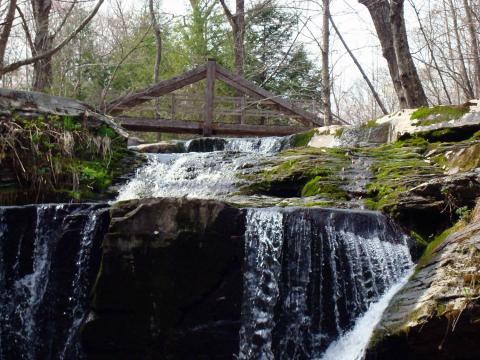
Blue Mtn. Photos found a hidden waterfall in Blue Mountain, near Saugerties, last week and snapped this photo of it, which he posted to the Watershed Post Flickr pool. He says that it wasn't easy to get the shot:

I think it's just over the County line into Green County. Taken off the narrow road bridge ...  All the properties nearby were posted, so this was all I could get.

If you have a Catskills photo you'd like to see on the Watershed Post, post in in our Flickr photo group pool.

Topics: 

Pure Catskills gives out $50,000

Fifty grand from the Watershed Agricultural Council (via its Pure Catskills program) and the NYC Department of Environmental Protection is going to 15 local businesses to fund things like local soup at Good Cheap Food in Delhi and livestock processing at Neversink Farm in Claryville. The full list of grant-winners is below, and is reposted on the Pure Catskills blog.

Recipients of the 2010 program include:

Delaware County:

· Byebrook Farm, Bloomville - Marketing: farmstand improvements $1,200

· Fable Restaurant at Stone & Thistle Farm, East Meredith - Product Development: seasonal, local, organic meat specialty products $2,740

· Farm Catskills, Delhi - Outreach and Education: "Food for Thought" farm-to-school events $5,000

· Good Cheap Food, Delhi - Product Development: local soup $5,000

Pages

Subscribe to Watershed Post RSS